Moves
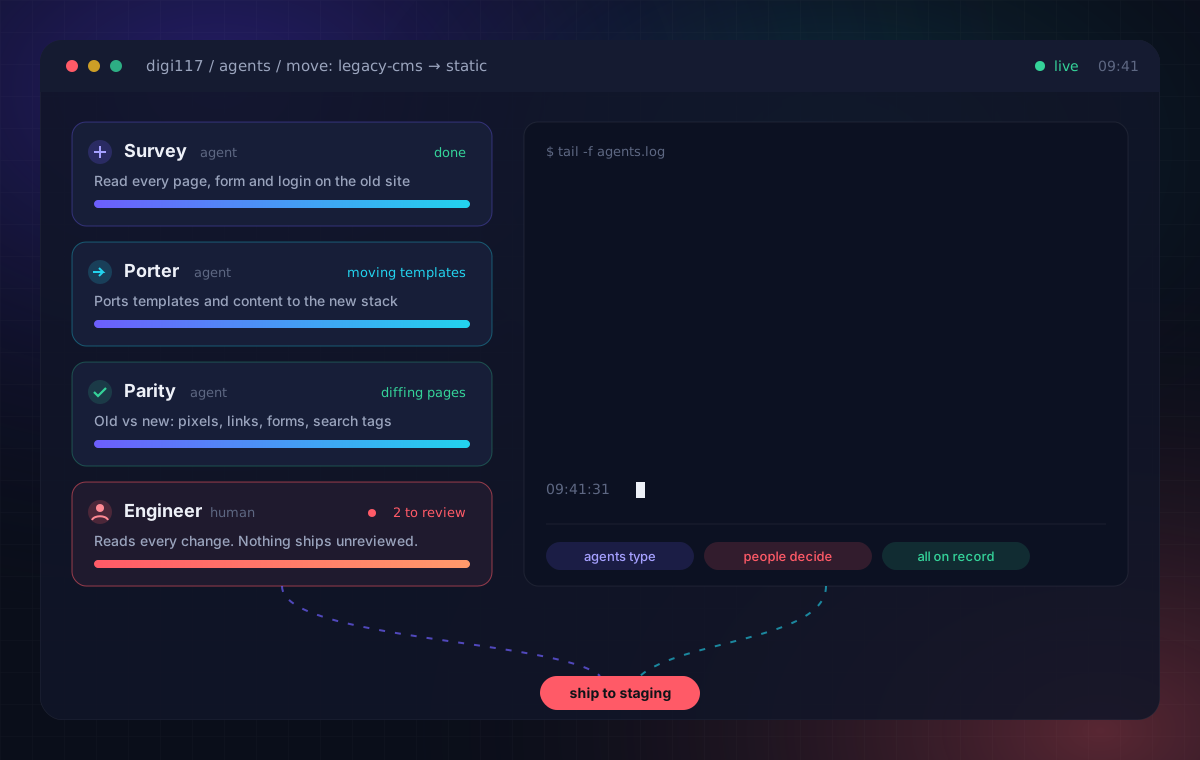
Off Drupal, Joomla, Kentico, Umbraco, old WordPress and old PHP before support ends. Inventory first, then a fixed quote.
Professional Makers of Things
DIGI117 is senior engineers in Vancouver, trained from the metal up, for the projects other teams pass on: old platforms that must move, products that must ship, AI that must earn its cost, and code that must stop breaking. Agents do the typing. We write the spec, review every diff and answer for the result.
What We Make
We take work with a deadline, a mess, or both. Weekly demos, a shared channel, and decisions written down where you can read them.
Off Drupal, Joomla, Kentico, Umbraco, old WordPress and old PHP before support ends. Inventory first, then a fixed quote.
A first version real users can sign up for, in 8 to 12 weeks. Scope fixed in writing, a demo every week.
Products, internal tools and integrations built to be run and changed, not only demoed.
AI inside a product or process that already exists. We measure the cost per task before we promise the savings.
An app that breaks under real users, often one an AI tool built over a weekend. Five-day audit, then a fixed-price fix.
Senior engineers inside your team, any team size. Named people, level on every invoice.
What it costs
Moves start at $4,900. Rescue audits are $4,500 and count toward the fix. Most MVPs land between $45,000 and $90,000, after a $4,500 scope sprint. Custom software starts from $25,000. An AI map is $5,900, and a pilot starts from $15,000. All prices in US dollars. Every job is quoted in writing before work starts. (Project work has no hourly rate card. Engineers start from $150 an hour. Every invoice lists hours by person, level and task.)
Free tools
No signup to use them. They run in your browser and send nothing anywhere.
Drupal, PHP, .NET, Node, Umbraco, Kentico and more: when the security fixes stop, and how many days you have.
What a task costs by hand, and with a model plus a person checking. Before anyone promises savings.
Ten questions from day one of a rescue, with a to-do list at the end.
Ten questions that separate a team from a sales deck. Us included.
Since 1994
We have made software since 1994: BASIC on the ZX Spectrum, Assembler on early x86 machines, then every language, database and tool that came after, up to today's AI agents. Oracle and SQL Server from their older versions to the current ones, PHP 4 and TypeScript, CGI scripts and serverless. We shipped on all of it, so moving off any of it holds no mystery.
BASIC on the ZX Spectrum, Assembler on early x86 PCs, MS-DOS and its 640K
C, C++, Pascal, Perl CGI, HTML from before CSS existed
Java, .NET, PHP, Oracle, SQL Server, MySQL, stored procedures and nightly batch jobs
Swift, Kotlin, Python, Node.js, PostgreSQL, MongoDB, AWS, Docker
TypeScript, React, Kubernetes, Cloudflare, vector search, AI agents with a person reviewing every diff
# 1994, ZX Spectrum
10 PRINT "HELLO"
20 GO TO 10

# x86, MS-DOS
MOV AH, 09h
MOV DX, msg
INT 21h

# 2026
$ agents run --task "move the site"
✓ templates ported, parity checked
● waiting for a person to review

# same habit, 32 years apart:
# nothing ships unread.
2026
The tools change every quarter. The habits do not: write the spec, test before you trust, keep a person on the merge button.
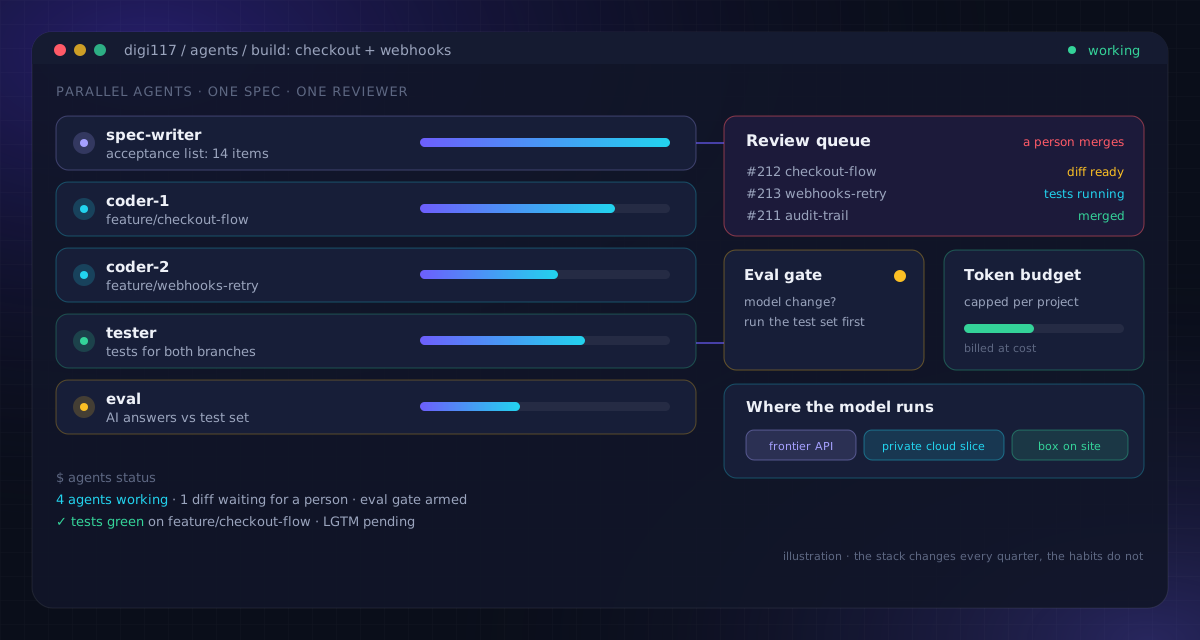
Parallel coding agents work from a written spec and an acceptance list. A senior engineer reviews every diff. Agents never merge their own work.
Every AI feature ships with a test set. A prompt or model change that fails it does not ship, however good the demo looked.
Design system first, WCAG 2.2 AA, real phones. Agent screens show what the AI did and wait for a person on the parts that matter.
TypeScript, Python, Go where it pays. Queues, retries and idempotent jobs, so a timeout does not charge a card twice.
Postgres first: row-level security, pgvector for search, an audit log on every write, migrations that run forward and back.
Data stays in your accounts. Model calls go only to vendors named in the proposal, on terms that exclude training on your data, in your region where the vendor offers it. Access logged per person and per agent. How we handle it.
AWS, Azure, Google Cloud and Cloudflare, on your accounts. Infrastructure as code, so the next team can read it instead of guessing.
When data cannot leave: open-weight models on a dedicated cloud slice, a GPU box on your site, or a desktop unit such as NVIDIA DGX Spark.
Small models fine-tuned for one narrow job, when they beat a frontier API on cost, speed or privacy. Measured against the same test set.
Hours per feature and cost per task, tracked. Token spend capped per project and billed at cost, on its own invoice line.
Senior, the long way
Our engineers learned the stack from the bottom up, before Stack Overflow could do the remembering. That is why a move, a rescue or an AI build does not stall when the problem turns out to live one layer lower.
Linux, networks, DNS, CI/CD, cloud and bare metal. We read the logs before we blame the network.
C, Assembler, memory, threads, profilers. When the framework hides the bug, we go under the framework.
APIs, queues, caches, transactions that do not lose money. Idempotent by habit, not by incident report.
Schema changes, migrations, replication and backups that have actually been restored.
Our Process
Speed comes from cutting waste, not corners.
The first call costs nothing. Then a short first step gives you a written scope, what we would cut and why, and a fixed-cost quote. For a move it is the inventory. For an MVP, AI or a rescue it is a fixed-price step whose fee counts toward the build.
Short sprints with a demo every week. AI agents write code and tests; a senior engineer reviews each change. Scope changes are priced before they are built.
We ship, then support. A clean handoff or an ongoing engineering partner, with no lock-in either way. You own the code.
In a Client's Words
Numbers in our research link to their sources. Client results are as the client reported them.
Digi117 clearly understood our objectives and stayed on course with that in mind. They have flawless software application development and customer service.
Senior engineers in Vancouver for hard software projects. We move sites and apps off old platforms, build MVPs and custom software, put AI to work in products and processes that already exist, and rescue apps that break. We also add senior engineers to existing teams.
We make working products, not decks. Every engagement ends in something you can run, measure and change, and every decision along the way is written down with its reason.
AI agents write code, tests and first drafts on our own tooling. A senior engineer specifies the work, reviews every change and decides what ships. Nothing reaches your product unreviewed. See the Peoplarium estimate for what this changes in hours and cost.
Most take 8 to 12 weeks from kickoff to launch. We quote after a scoping session, so the timeline rests on the scope, not on optimism.
Moves start at $4,900; stores and web apps from $18,900. A rescue audit is $4,500, credited to the fix, and stabilizing is $9,500. An MVP scope sprint is $4,500, and most MVPs land between $45,000 and $90,000. Custom software starts from $25,000. An AI map is $5,900, and a pilot starts from $15,000. Engineers start from $150 an hour. Every job is quoted in writing before work starts. See how we price.
Yes. Most of our clients are US startups and tech companies. We work in US business hours from Vancouver and communicate in plain English.
Whatever your system runs on. We have written software since 1994, from Assembler and BASIC to Java, .NET, PHP and Oracle, to today's TypeScript, Python, React, Node.js, PostgreSQL, AWS, Google Cloud, Azure and Cloudflare. For AI, OpenAI, Anthropic and custom pipelines. New builds follow the product; moves start from what you have.
Yes. Named Digi117 engineers join your team, any team size, on your tools (Jira, Linear, Slack, GitHub) and your process. Most start contributing in the first week.
Send a few sentences and, if there is code, read access. We reply within one business day with what we would do first and what it costs.
We sign an NDA before any discovery or scoping conversation. You own the code: IP transfers to you in full on final payment.
We will tell you the fastest route to a working product, what we would cut, and what it will cost. No commitment.
Reply within one business day · No sales sequence, no spam